Friends of Gualala River Protecting the Gualala River watershed and the species living within it
Presentation to the Washington Department of Ecology:
6PPD-Q State of the Science Forum on December 9, 2025
Presented by Laura Baker, Friends of Gualala River, and
Timmarie Hamill, CA Urban Streams Alliance-The Stream Team
Abstract
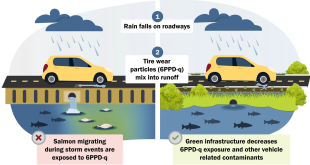
In 2022, CA Urban Streams Alliance-The Stream Team (The Stream Team) expanded its long-standing watershed monitoring program and began collaborating with Friends of Gualala River (FoGR) to investigate 6PPD-Quinone (6PPD-Q)—a tire-derived pollutant highly toxic to Coho Salmon and Steelhead—in the Gualala River estuary.
Using an updated monitoring plan and QAPP, storm-event samples were collected at four sites upstream and downstream of major road surfaces and analyzed for 6PPD-Q, zinc, oil and grease, and standard field parameters. Results show elevated 6PPD-Q (up to 170 ng/L), zinc, conductivity, and turbidity, with highest concentrations at sites influenced by Highway 1, gas stations, and parking lots.
These findings indicate roadway runoff as the primary pollution source and establish critical baseline conditions ahead of planned estuary restoration and the CalTrans Gualala Downtown Streetscape Enhancement project. Data will support targeted recommendations for green infrastructure and stormwater-mitigation measures to reduce toxic runoff and protect sensitive salmonid habitat.
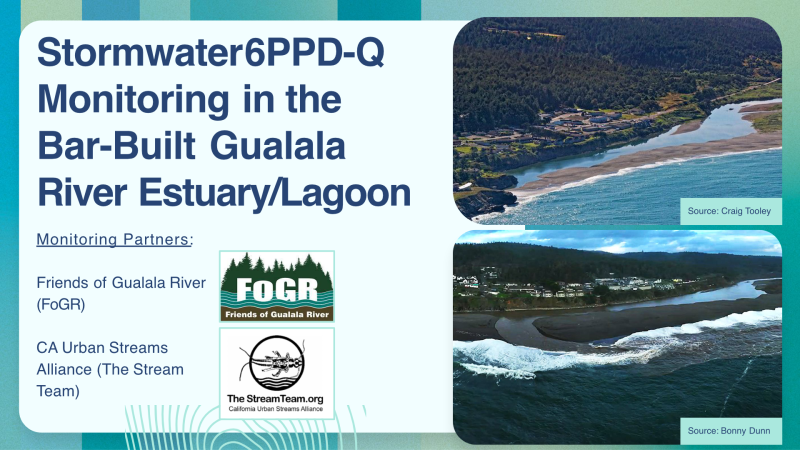
First, thanks to our team: Timmarie Hamill, our partner from The Stream Team, Dylan Freebairn-Smith, Conservation Analyst for Friends of Gualala River, and volunteer, Beth Roland.
The photos in the slide show the Gualala estuary in two different phases. The upper photo shows the lagoon phase with the mouth of the river closed by the large sandbar. The lagoon phase usually begins in late spring or early summer with the end of the rains and decrease in freshwater flows.. The lower photo shows the estuarine phase when the mouth is open and the river is subject to tidal flow. The hydro dynamics of the estuary are complex, and the runs of our salmonids are adapted to these complex cycles, with spawners returning from the ocean, and smolts ready to begin their ocean phase when the mouth opens.
In the upper photo you can see Highway 1 which passes through the town of Gualala and is the only thoroughfare. The town is situated on a narrow marine terrace perched directly above the river, and behind it is the Pacific slope which is heavily forested. All the stormwater from the north end of town to the bridge at the south empties directly into the estuary/lagoon.
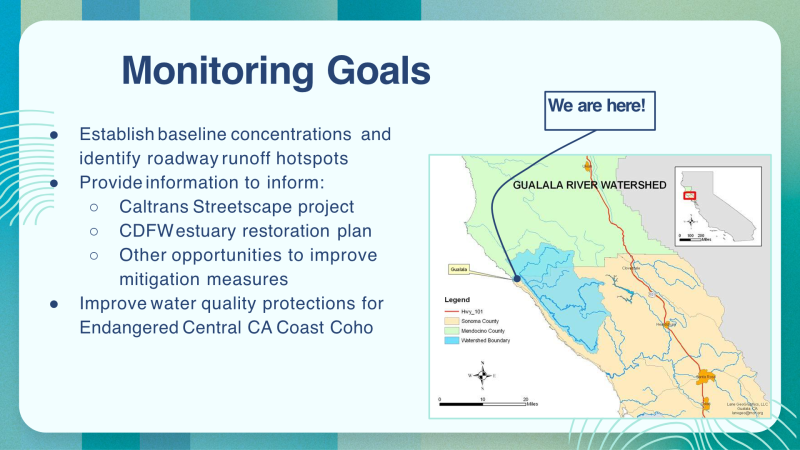
In 2023 when we first learned about 6PPD-Q, we began to investigate the Gualala stormwater system. Our endangered coho population has been nearly extirpated, and we have been working on water quality issues to aid in recovery. We regard the coho like the canary in the coal mine for the watershed.
We also thought that there might be an opportunity to work with Caltrans to improve stormwater mitigation because it has been in the process of developing a Streetscape Plan for downtown Gualala that would involve some stormwater treatment.
Once we identified all of the pipes, drains, and outfalls of the stormwater system, we hired an ecohydrologist, Greg Kamman, to produce a technical document to estimate the possible range of natural flows in each of the 3 sub watersheds and to propose possible mitigation for the stormwater.
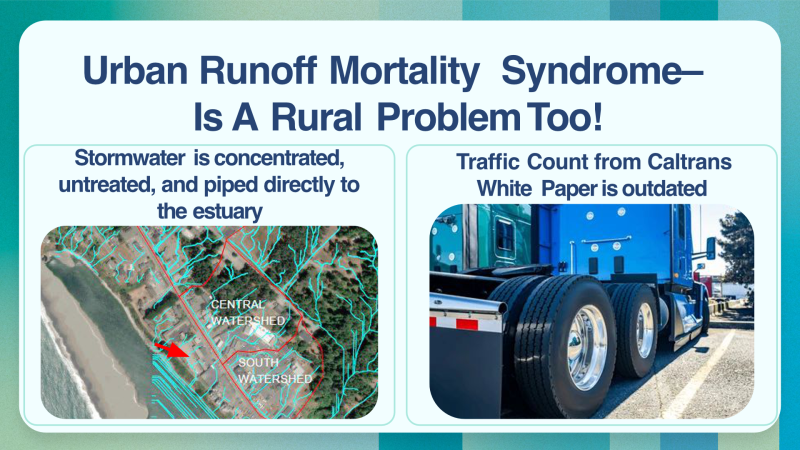
While most of the research that we encountered described the impacts of 6PPD-Q on coho as an urban phenomenon, we wondered whether the heavy concentrated traffic in Gualala might be a larger source of 6PPD-Q than assumed.
In 2012 Caltrans estimated the Average Annual Daily Traffic in Gualala as between 3041-3405 vehicles per day depending upon the month. However, these figures are misleading in terms of estimating the actual number of tires that pass through town on a daily basis. We have many large trucks, trailers, and other large vehicles that use Highway 1 because there is no alternative route. One 18-wheeler is comparable in terms of number of tires as 4.5 cars with super large tires. So we believe that the number of vehicles isn’t a precise enough metric to use.
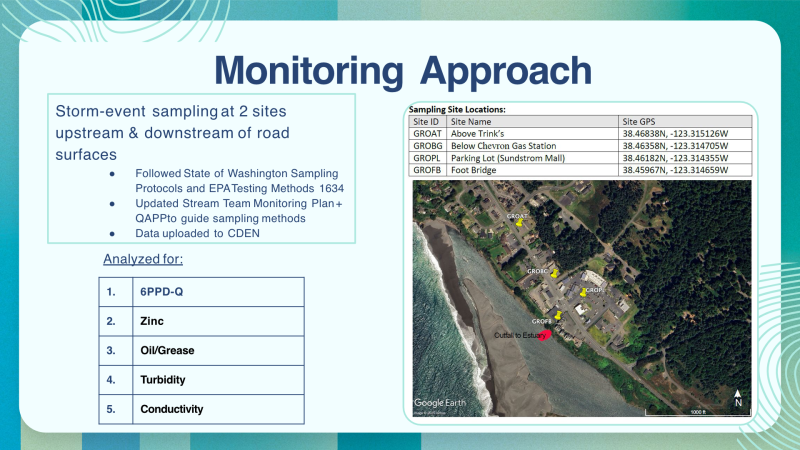
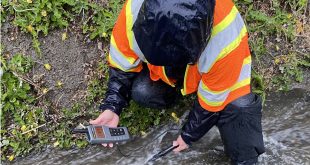
We did some preliminary testing of stormwater runoff during rain events, following the State of Washington Sampling Protocols to determine concentrations of Zinc, Oil and Grease, Turbidity, and Conductivity.
Once the EPA Testing Method 1634 was approved for lab analysis of 6PPD-Q, we began to collect samples from two different sites. We also updated The Stream Team Monitoring Plan and QAPP to guide our sampling methods. And we uploaded our data to CEDEN.
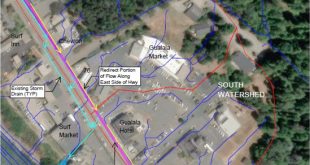
The photo shows yellow pins in our initial testing sites. The red dot shows the main outfall from the central watershed which gathers stormwater from Highway 1, two gas stations, and half of a large parking lot.
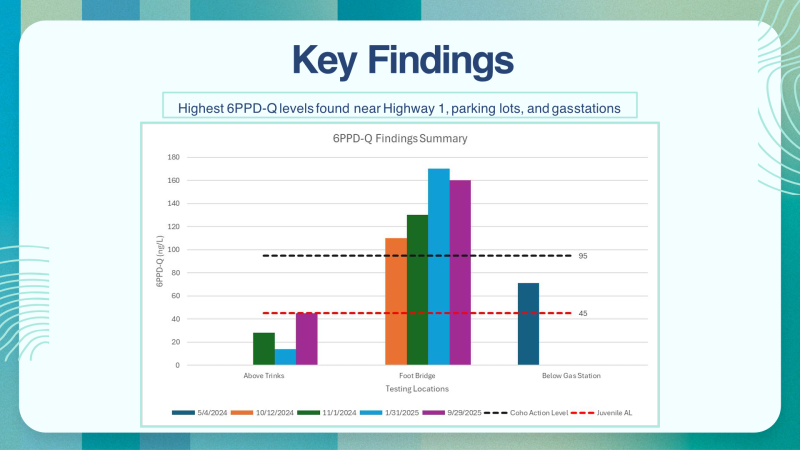
The bar graph shows 3 groupings of sampling periods at 3 different sites. The left side of the graph shows 6PPD-Q in nanograms/liter. Each color represents a different sampling event. As you can see, there are large differences between the three sites.
The red dotted line shows the action level (or LC-50) at 45 nanograms/liter for juvenile coho, and the black dotted line shows the action level (or LC-50) at 90 nanograms/liter for adult coho.
The middle testing location is where the stormwater from the central sub watershed is concentrated as mentioned above. This drain consistency shows the highest levels of 6PPD-Q.
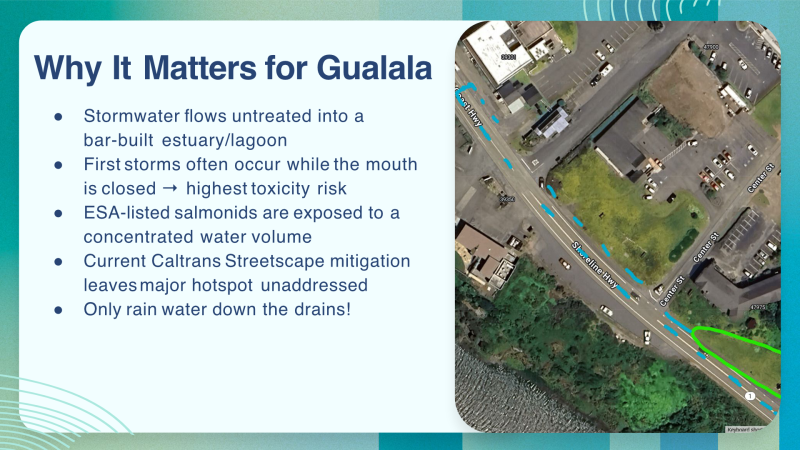
Every drop of stormwater from Gualala is untreated, concentrated in pipes, and shot into the estuary/lagoon. The early storms in October usually occur when the mouth is closed and not subject to tidal flushing but stormwater is flowing into the lagoon. This represents a potential exposure of salmonids in the lagoon to 6PPD-Q.
The Caltrans Streetscape Project will treat some stormwater as shown in the photo where there are blue dashed lines where vegetation will be placed along the street and a green ellipse that shows the location of a bioswale planned for the project.
However, the stormwater that poses the largest threat (the Central Sub Watershed) will not be adequately treated.
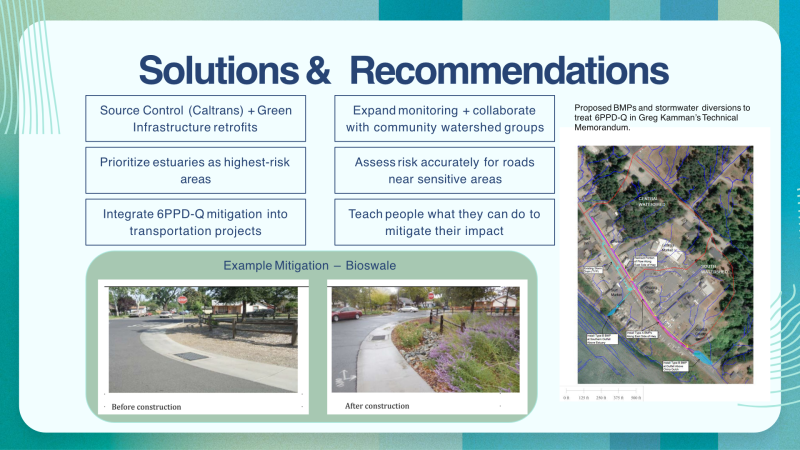
There are possible solutions that can be employed. Because the stormwater system in Gualala was built to prevent flooding, the actual volume of water is itself a problem. Installing green infrastructure that captures and treats the water both in the uphill area and in town along Highway 1 would accomplish both goals.
We believe that, as Caltrans establishes priorities for areas of high risk from 6PPD-Q, estuaries should be at the top of the list, with coho streams the very highest. Bar-built estuaries that are closed for portions of the year should also be considered a high priority. And those areas, like Gualala, where a town sits above the estuary/lagoon should also be ranked high.
Mitigation for 6PPD-Q should be integrated into every transportation project that crosses a salmon stream.
Monitoring for 6PPD-Q should be incorporated into the Basin Plan for the North Coast. The Water Board should encourage collaboration with community watershed groups.
The State of Washington has a campaign to inform the public of steps that they can take to reduce their own impact by doing simple things like keeping their vehicle tires properly inflated. We’ve borrowed some of their ideas and come up with some of our own to create an article for the local public on our website, Gualalariver.org.
Thank You!
Presenter biographies
Laura Baker (Friends of Gualala River): Laura holds an M.A. in Ecology and Systematic Biology from San Francisco State University. Now retired, she has since spent many years leading conservation initiatives and volunteering on conservation and environmental advocacy projects with non-profit organizations including the Friends of Gualala River, the Redwood Coast Land Conservancy, and the California Native Plant Society. She lives in the Gualala River Watershed.
Timmarie Hamill (CA Urban Streams Alliance-The Stream Team): Timmarie holds a B.S. in Biology and a Secondary Math and Science Teaching Credential from California State University at Chico. As a biologist, she has planned and conducted water quality inventories as they relate to fish and wildlife in the private and public sectors for over 20 years. She has served as an Industrial Waste Inspector for the City of Chico, Pretreatment Plant Operator for the City of Oroville, HAZMAT biologist for Army Corp. of Engineers, consultant preparing CEQA and NEPA reports, science teacher for a small Charter School, and most recently, project manager for watershed assessment, and storm water education grants.
Recordings and related resources for the entire two day Forum are available online: